Which designs exist: barrel sauna, sauna house or cube
Anyone planning an outdoor sauna first decides on the design, because it determines space requirements, heating behaviour, comfort and budget. Three basic types dominate the German market: the horizontal sauna barrel, the classic sauna house with or without anteroom and the modern cube with a flat roof and clean edges. All three arrive in the garden as a kit, but differ more in everyday use than the catalogues suggest.
The barrel sauna is the entry-level favourite: its round shape encloses little air volume, so it reaches temperature faster than an angular room of the same length. Add the striking look and the fact that almost all barrels are sold as a complete set with heater and accessories. The downside: there is hardly any storage space in the barrel, no real changing area, and the curve costs a little headroom at the benches. Our big comparison of the best barrel saunas shows which models are worthwhile.
The sauna house is the comfortable year-round solution. With an anteroom you get changing area, draught lobby and storage space in one; without an anteroom it remains a compact sweat room in a classic house shape. Sauna houses offer vertical walls, full headroom and usually more bench area, but in return cost more money, more garden space and more often a round of paperwork, because larger buildings more easily slip into size classes that require a permit.
The cube is the design answer to the sauna barrel: flat roof, large glass front, clean lines. It suits modern garden architecture perfectly and also works as an eye-catcher next to a pool or terrace. Technically the same applies as for the house: vertical walls, good use of space. With a flat roof you should make sure of clean water drainage and a weatherproof roofing membrane, so that standing water does not damage the wood.
Foundation and installation site
Every garden sauna needs a level, load-bearing and ideally frost-proof base. Two approaches have proven themselves: the slab foundation made of concrete, which spreads the load over a large area and safely carries even heavy sauna houses, and the point foundation, where concrete points or paving slabs sit only under the support points. For smaller barrel saunas a properly compacted gravel bed with slabs is often enough. In any case it is important that air can circulate under the floor: if the wood stands permanently in waterlogged ground, even the most beautiful sauna ages in fast motion.
When it comes to the installation site, a moment of planning is worthwhile. The door should not face the prevailing wind direction, otherwise every entry and exit is unpleasantly draughty. A spot with a view into the garden makes the rest phase more valuable, short paths to the house make the walk to the shower easier in winter. And think of the neighbours: boundary distances must be observed, and a wood-fired heater with a chimney directly on the property line rarely makes for a good atmosphere. A short conversation before construction saves long discussions afterwards.
Power and heater: planning 400 volts correctly
The heart of every outdoor sauna is the heater, and it needs to be supplied. Most garden saunas run on electric heaters in the 9 kilowatt class, which need a 400-volt connection. For this a buried cable is laid from the house connection to the sauna, and this part belongs without exception in the hands of a qualified electrician: cable cross-section, fuse protection and residual current protection are not for the after-work DIYer. It is best to plan the cable before the foundation, so nobody has to dig up the finished path later. Only small barrel heaters with 3.6 kilowatts make do with a normal 230-volt socket on their own circuit.
The alternative is the wood-fired heater: no buried cable, no running electricity costs and a sauna climate with crackling that many regard as the more original experience. In return you need a chimney, firewood and patience when lighting it. Important: a wood-fired sauna must be signed off by the responsible chimney sweep before first use, who also checks the distances to combustible building parts. Which heater type suits which sauna type and how the output classes differ is explained in our big sauna heater buying guide.
Wood and wall thickness: 38, 42 or 70 millimetres
For garden saunas sold by mail order, three wall thicknesses have become established. 38 millimetres is the entry-level standard: entirely sufficient for the season from spring to autumn and for occasional winter sessions. 42 millimetres retains heat noticeably better, the heater needs to top up less often and the sauna holds its temperature more steadily even in frost. If you use your sauna all year round and several times a week, go for the 70-millimetre log wall: it is the most comfortable but also the most expensive solution, with the most even and pleasant climate.
For the material, Nordic spruce dominates, which is light, dimensionally stable and affordable. Higher-quality models use thermally treated spruce: the heat treatment makes the wood darker, it absorbs less moisture and warps less. After assembly, you should coat untreated exterior surfaces with an open-pore wood protection glaze; the interior generally stays untreated. Prepared like this, a garden sauna is winter-proof without any problem, because cold does not harm the wood, only permanent dampness does.
Building permission at a glance
The most common question before buying is about permits, and the honest answer is: it depends, because building law is a matter for the individual states. Each federal state defines its own limits for when an outbuilding remains exempt from permit procedures, usually depending on enclosed volume or floor area, on its position on the plot, and on whether a fireplace is installed. A compact barrel sauna without a living space is unproblematic in many places, whereas a large sauna house with an anteroom and wood-burning stove may require a permit. Do not rely on forum knowledge: a short call to the local building authority with the key details of your project provides clarity before any money is spent. We have summarised the details on boundary distances, fireplaces and typical pitfalls in the guide Garden sauna and building permission. Neither this article nor the guide replaces legal advice.
Our recommendations in detail
From the current offering we have selected three models that cover the most important buying situations: a compact complete package with heater, a design cube and a classic sauna house. All technical data comes from manufacturer and retailer information, and all ratings are editorial ratings by our editorial team.

Karibu garden sauna 195.6 x 189.9 cm
- Complete set with 9 kW heater, external control and sauna stones: after assembly, only the power connection is missing
- A footprint of just under two by two metres fits into smaller gardens too
- Solid spruce and bronzed glass door look considerably higher quality than the price would suggest
- Two benches for relaxed sauna sessions for two, up to four people can sit
- The 9 kW heater requires a 400-volt connection by a qualified electrician
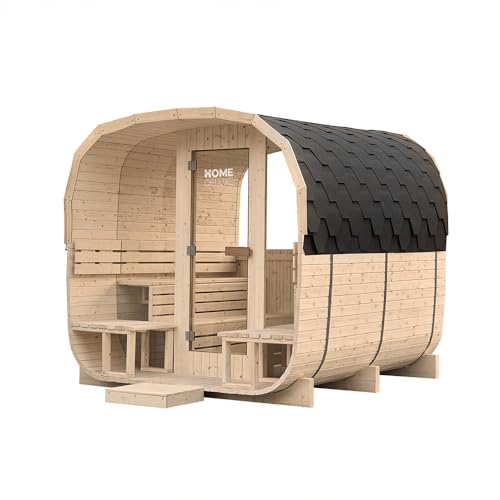
Home Deluxe garden sauna Hygge Deluxe
- Striking, modern look that is more reminiscent of a small spa than a garden shed
- With a footprint of around 230 x 220 centimetres, enough room for sociable sauna sessions
- Home Deluxe is established in the wellness segment and easy to get hold of in German-speaking countries
- Needs visible space in the garden and careful planning of the foundation and power connection
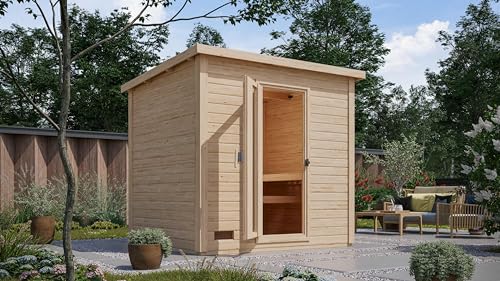
Karibu sauna house MELO 3 (Chillroi)
- Classic sauna house design with vertical walls, full headroom and proven Karibu construction
- 38 millimetres of wall thickness comfortably carry the season from spring to autumn, and with a suitable heater, winter sessions too
- Untreated wood leaves a free choice of glaze and colour to match the garden
- Heater optional: if you want to choose one yourself or use an existing heater, you do not pay twice
- Without a heater in the set, the heater purchase and electrical planning must be budgeted separately
Which solution suits whom
The short decision aid from the editorial team: if you are buying an outdoor sauna for the first time and are looking for a fair complete package, take the Karibu garden sauna with 9 kW heater, because everything from the heater to the sauna stones is included. If looks come first and the sauna may be an eye-catcher next to the terrace or pool, the Hygge Deluxe is the right choice. If you want the classic sauna house feel with vertical walls and would like a say in the heater, go for the MELO 3. And if you want to start outdoor sauna bathing as quickly and cheaply as possible, the comparison of the best barrel saunas has complete sets, some of which run on a normal socket.
If you have no garden or the walk outside puts you off in winter, the home sauna in the cellar or bathroom is the obvious alternative: no foundation, no underground cable, but you need to check ceiling height and ventilation. For the extras, take a look at our accessories overview, from infusion scents to the sauna clock, and the guide how to sauna properly explains how to organise heat-up time, rounds and cooling down sensibly.
Looking specifically for a family size? In the comparison Garden saunas for four people we calculate space requirements, bench areas and suitable heater output for this size separately.
Conclusion
A garden sauna is not an impulse buy, but it is not rocket science either. If you answer the four core questions properly, namely design, foundation, power connection and permit, you get a private spa that lasts many years for a mid four-figure sum. Our recommended approach: first clarify the conditions with the building authority, then arrange the qualified electrician for the underground cable, then choose the model. The barrel sauna remains the quickest and cheapest way in, the sauna house the most comfortable long-term solution, the cube the finest stage. You cannot go wrong with any of the three designs as long as the foundation and electrics are right.