The seven recommendations at a glance
Seven cabins, four brands, one shared criterion: genuine full-spectrum heaters as standard. The table shows the key data at a glance, followed by the details on each model and an assessment of who each layout suits.
| Model | People | Footprint | Heaters | Special feature | Rating |
|---|---|---|---|---|---|
| Artsauna Kiruna90 | 1 | 90 x 90 cm | 4 full-spectrum + 3 panel | Glass door, LED colour light | 4,4/5 |
| Artsauna Kiruna90 Premium | 1 | 90 x 90 cm | 4 full-spectrum + 3 panel | dimmable back emitter | 4,3/5 |
| Artsauna Trondheim120 Natur | 2 | 120 cm wide | Full spectrum, 2,200 W | light natural look | 4,2/5 |
| Artsauna Trondheim90 Natur | 1 | 90 cm wide | Full spectrum, 1,705 W | light natural look | 4,2/5 |
| Home Deluxe Sahara XXL | 2 to 3 | 150 x 150 cm | 8 full-spectrum | Family format | 4,1/5 |
| Dewello Saltcoats | 1 to 2 | 120 x 120 cm | Full spectrum + floor | Natural salt stone, Bluetooth | 4,1/5 |
| Sanotechnik Malmö 1 | 1 | 90 x 90 cm | 4 full-spectrum + carbon | 8 mm toughened glass, Bluetooth | 4,0/5 |
The cabins in detail

Artsauna Kiruna90
- Four full-spectrum and three panel heaters combine fast direct heat with mild base warmth
- On 90 x 90 centimetres of floor space, the cabin fits into almost any free corner
- LED colour light and full glass door create a wellness feel instead of a boxy look
- Runs on a normal 230-volt socket, no electrician needed
- The bench simply isn't designed for two people

Artsauna Kiruna90 Premium
- The dimmable back heater lets you adjust the heat across the back steplessly
- Otherwise the proven Kiruna90 base with full-spectrum front, panel heaters and glass door
- Ideal for anyone who wants to dose the heat intensely at times and gently at others
- The comfort surcharge is only worth it if you really use the dimming function

Artsauna Trondheim120 Natur
- 2,200 watts of full-spectrum output according to the manufacturer gets two people sweating quickly
- The light natural look feels homelier than the classic dark cabin front
- A width of 120 centimetres stays easy to place in a bedroom or hobby room
- Young model line, long-term experience is still limited

Artsauna Trondheim90 Natur
- 1,705 watts of full-spectrum output is more than enough for the compact solo cabin
- Same light natural design as the larger Trondheim120
- A slim 90 centimetres makes finding a spot easy
- For occasional use by two, it simply lacks the width
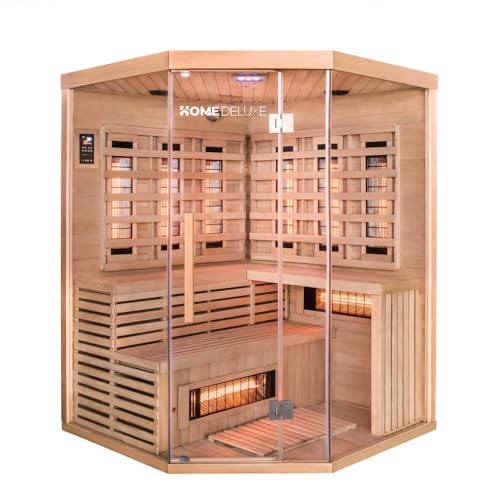
Home Deluxe Sahara XXL
- Eight full-spectrum heaters distribute the heat generously across the corner cabin
- 150 x 150 centimetres give two adults real elbow room, with space for a third guest as well
- Full standing height of 200 centimetres, made of hemlock
- Needs noticeable floor space and is priced above the compact models

Dewello Saltcoats
- Illuminated natural salt stone creates a warm lighting mood like in a salt cave
- An additional floor heater warms the feet, where many cabins stay cool
- Bluetooth and LED colour light complete the wellness package
- The salt stone is mainly about atmosphere, you should not attribute medical effects to it

Sanotechnik Malmö 1
- Four full-spectrum heaters at the front, a mild carbon heating plate at the back: a pleasant mix of heat
- Eight-millimetre toughened safety glass feels high-quality and sturdy
- Bluetooth and LED colour light are on board as standard
- With room for one person, it remains strictly a solo cabin
What full spectrum actually means
Infrared is simply thermal radiation, divided into three wavelength ranges. IR-C is the longest-wave range: it acts mainly on the skin surface and makes up the lion's share in classic carbon and panel heaters. IR-B lies in the middle, and the short-wave IR-A penetrates deepest into the skin; its share produces the intense, sun-like feeling of heat that distinguishes full-spectrum cabins.
Full-spectrum heaters combine all three ranges in one tube that glows visibly reddish. In practice this means: the heat is noticeable after a few minutes, acts directly on the skin and can be aimed specifically at the back or front. An important note: this is wellness, not a medical treatment. If you hope for relief from specific complaints or live with pre-existing conditions, check with a doctor before using it; our guide Is a sauna healthy? offers a sober assessment.
In practice, a typical session looks like this: about ten minutes of warm-up, then 20 to 40 minutes of mild heat at an air temperature of 40 to 60 degrees. Because full-spectrum heaters act directly on the skin, you ideally sit upright in the radiation field instead of lying down as in a Finnish sauna. Many cabins therefore combine the full-spectrum front with panel heaters at the back, so that the heat comes from all sides.
Whether an infrared cabin or a classic sauna suits you better is answered by the fundamentals article Infrared cabin or sauna. The basics on emitter types, wood species and controls are covered in our big infrared cabin buying guide.
When the extra cost is worth it
Pure carbon cabins are often somewhat cheaper than comparable full-spectrum models. The extra cost is worth it whenever you prefer short, intensive heat sessions: full-spectrum emitters are ready for use faster, get the body sweating more quickly and, in good cabins, can be controlled in stages. In the Kiruna90 Premium they can even be dimmed continuously.
The extra cost is dispensable if you prefer long, mild sessions in gentle warmth or mainly use the cabin as a warm retreat for reading. In running costs the two systems differ little: rated power and usage time are what matter. You will find the concrete calculation in the guide to the electricity consumption of saunas and infrared cabins.
One more honest caveat: more emitters do not automatically mean more benefit. What matters is that the emitters sit where your body is, that is at the front, back and ideally calves. A well-laid-out cabin with five emitters beats a poorly laid-out model with eight in everyday use; that is exactly why we weight the arrangement more heavily than the sheer number.
Which cabin suits whom
If you are usually the only person sweating, the Kiruna90 is the clear buy: combined emitters, colour light, glass door and a footprint that fits into any corner. The Premium version is worthwhile for anyone who wants to fine-tune the back heat, the Sanotechnik Malmö 1 is the solid alternative with a carbon back plate and thick tempered glass, and the Trondheim90 Natur brings a bright, living-room look into play.
For two people the way leads to the Trondheim120 Natur with 2,200 watts of full-spectrum output; our comparison of infrared cabins for 2 people offers even more choice in this class. Families and anyone with room to spare should take the Sahara XXL, whose eight emitters leave nobody sitting in the cold even with three people. Finally, the Saltcoats is the cabin for atmosphere fans: illuminated natural salt stone and floor emitters make it the most atmospheric model in the field.
How we assessed
Our editorial rating weighs four criteria: the heating technology (number, type and arrangement of the emitters), the workmanship of wood, glass and bench, the features from controls to multimedia, and everyday practicality in terms of footprint, connection and assembly effort. The basis is manufacturer and retailer information as well as documented user experiences, not our own laboratory measurements, and that is exactly how we label it. Price classes instead of daily prices are a principle with us; what the editorial team stands for is explained on our page about us.
Honesty also requires a note on health: infrared heat relaxes muscles and circulation in a mild way, but does not replace medical treatment. In the case of cardiovascular disease, pregnancy or acute infections, check with a doctor before your first session whether and for how long you should sweat.
Conclusion
Full spectrum is the right choice for anyone who wants to feel heat rather than merely sense it. The Kiruna90 remains the benchmark of its class, the Premium upgrade refines the dosing, and Trondheim120 and Sahara XXL scale the concept to two or more people. Buy by footprint and usage scenario, not by emitter count alone: a suitable cabin that runs regularly beats any data-sheet monster that ends up as a coat rack.